When tracking AI visibility for your brand, you’d want to know how individual pages perform, including that one-off seasonal landing page or that competitor article that keeps showing up in AI answers.
But with how the traditional AI visibility workflow is designed (add prompts, pull citations, and analyze the visibility based on those), adding your own URLs to the mix isn’t possible.
To tackle this issue, we are introducing Page Tracker in Writesonic.
Page Tracker: Monitor Performance for Any URL You Care About
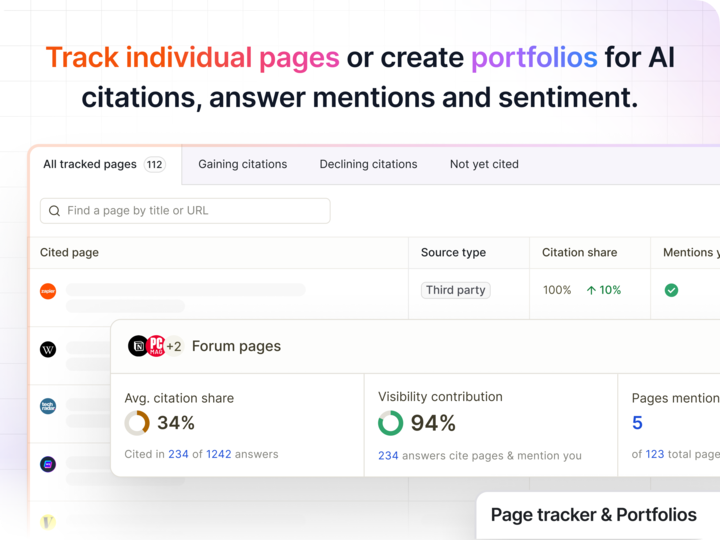
Page Tracker lets you track any URL, whether it’s on your domain or not, and see exactly how it performs across AI platforms.
Add individual URLs or upload a CSV with hundreds of pages.
Once added, data collection starts in the next 24-hour cycle. Then you can see citation trends, platform breakdowns, brand mentions, and competitive context for every tracked page.
With Page Tracker, you can finally:
Measure the ROI of PR and Third-Party Placements
You spent $10,000 on a Forbes article. Does it actually drive AI visibility? Is ChatGPT citing it? Are those citations mentioning your brand?
Page Tracker shows you the answer. Add the URL, and you’ll see:
- Citation trend over time
- Which AI platforms are citing it
- Whether those citations mention your brand
- How many competitors appear in the same context
- Topics driving citations to that page
You can measure their actual contribution to your AI visibility and report real ROI to stakeholders.
Track Campaign Performance at the URL Level
Seasonal campaigns and product launches, each have specific landing pages or content you need to monitor.
Add those URLs to Page Tracker and you can monitor how they perform across AI platforms during the campaign period and beyond.
See if citations increase during the campaign, whether they sustain after it ends, and which platforms drive the most visibility.
Monitor Competitor Content and Industry Benchmarks
See a competitor page you are particularly interested in? With Page Tracker, you can track any URL, even if it doesn’t belong to your own domain.
Add any competitor blog posts, product pages, case studies, and benchmark your performance against theirs. Identify content gaps where they’re winning and you’re not.
Organize URLs Into Portfolios for Strategic Analysis
Instead of tracking pages individually, group them into Portfolios: collections of related URLs you want to monitor as a unit.
Create portfolios for:
- Content types (blog posts vs. product pages vs. documentation)
- Marketing campaigns (Q4 2025 campaign, product launch, seasonal promotion)
- Competitor monitoring (Competitor A’s blog, Competitor B’s resources)
- External placements (all Forbes mentions, all industry publication features)
Each portfolio shows collective performance metrics:
- Average Citation Share: How frequently AI engines reference pages from this portfolio as sources
- Visibility Contribution: What percentage of your total brand visibility comes from this portfolio being cited
- Pages Mentioning Brand: How many pages in this portfolio mention your brand
With Portfolios, you can measure campaign impact collectively, and benchmark entire competitor content libraries against yours.
Marketing Needs Page-Level Measurement
Page Tracker is live now for all users.
This is the kind of granular tracking marketing teams have needed since AI search became a channel. Because to answer campaign metrics, you need page level view.
Add any URL. Group them into portfolios. Measure what matters to you.